
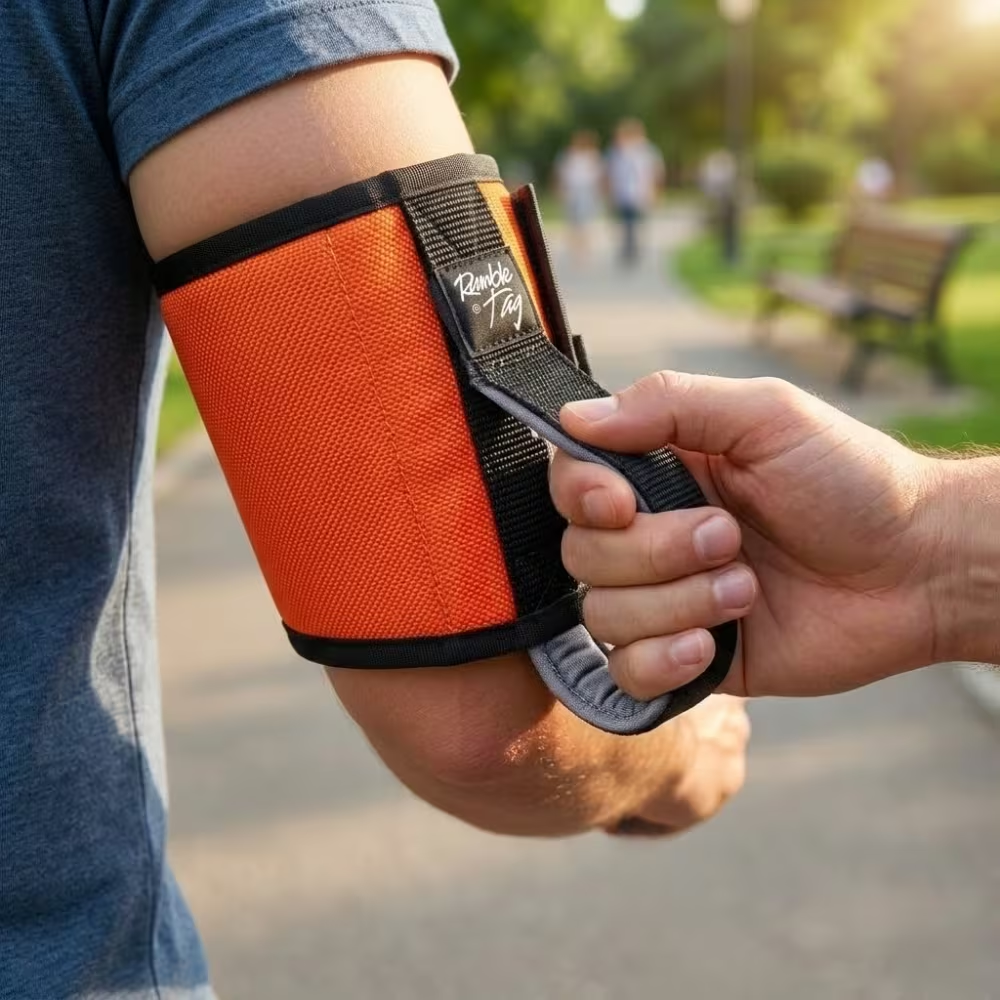
In accessibility, the most powerful innovations are often the simplest. Ramble Tag is a perfect example — not a piece of complex technology, but a thoughtfully designed physical guiding aid that improves comfort, dignity, and independence for blind and partially sighted people.
At Blind Ambition, we focus on what works in the real world. Ramble Tag is exactly that.
What Is Ramble Tag (Really)?
Ramble Tag is a lightweight harness-style guiding aid, worn by the guide on their:
- Upper arm
- Wrist
It provides a clear, consistent grip point for a blind or partially sighted person to hold while being guided.
This might sound simple — but that simplicity is exactly where its strength lies.
Rather than replacing human guiding, it enhances it.
Real Experience: Practical, Comfortable, Recommended
Seema Flower recently tried Ramble Tag in the Lake District over the weekend — a real-world environment with uneven terrain, changing surfaces, and the kind of unpredictability that truly tests accessibility tools.
Her conclusion was clear:
- It is a great device
- It feels natural and intuitive
- She would recommend it to anyone looking for a better way of guiding blind and partially sighted people
The Subtle but Powerful Shift: Independence Within Guidance
Traditionally, blind and partially sighted people are guided through:
- Holding someone’s arm
- Direct physical contact
- Close proximity movement
And while this is effective — and often essential — it can also:
- Feel intrusive in some situations
- Reduce personal space
- Create discomfort, particularly with unfamiliar people
Ramble Tag changes that dynamic.
It introduces:
- A defined point of contact
- A more neutral, respectful boundary
- A sense of independence within support
You are still being guided — but it feels different.
More controlled.
More comfortable.
More like your own movement.
“True accessibility is not about doing things for people — it is about removing the barriers so they can do it themselves.”
— Seema Flower
That small shift in experience is not insignificant. It can transform how confident someone feels moving through a space.
Why This Matters in Real Settings
Ramble Tag is already being used across a wide range of environments, including:
- Airports (including early adoption at Glasgow Airport)
- Train stations
- Hospitals
- Theatres and public venues
- Stadiums and attractions such as galleries
This matters because these are high-pressure, unfamiliar environments, where:
- Staff may not be trained in guiding techniques
- Physical contact may feel uncomfortable
- Speed and efficiency are required
Ramble Tag provides a consistent, reliable method of guiding, regardless of experience level.
Designed from Lived Experience
Ramble Tag was invented by Tom Forsyth, who is blind, alongside Laura Maclean, his neighbour and guide.
That origin story matters.
This is not theoretical design — it comes directly from:
- Real guiding challenges
- Real lived experience
- Real-world problem solving
Since Tom’s retirement in 2024, Laura has continued to independently promote and develop the product, ensuring it remains grounded in its original purpose.
Recognition and Impact
Ramble Tag’s impact has been recognised through:
- Finalist – RNIB Innovation of the Year Awards 2019
- Finalist – National Diversity Awards 2020
- Runner-up – Blackwood Design Awards 2019
It has also gained traction globally, with users reporting meaningful improvements in:
- Comfort
- Confidence
- Independence
Why Blind Ambition Supports This
At Blind Ambition, we often say:
Accessibility is not just about compliance — it is about experience.
Ramble Tag delivers:
- A better guiding experience
- A more dignified interaction
- A scalable solution for organisations
For businesses, this is particularly important. It offers a practical way to:
- Improve customer experience
- Support staff in providing assistance
- Reduce uncertainty in how to guide appropriately
Final Thoughts
Ramble Tag doesn’t try to replace human support — it refines it.
And in doing so, it unlocks something incredibly valuable:
independence within connection.
For blind and partially sighted people, that balance — between support and autonomy — is everything.


